
The Ins and Outs of Hiring a Florida Wrongful Death Lawyer
Understanding Florida’s Wrongful Death Act and Legal Eligibility
If you are considering hiring a Florida wrongful death lawyer, the first thing to know is that only the personal representative of the deceased person’s estate may file the lawsuit, and the claim must be brought within two years of the death. The personal representative then pursues compensation for both the estate and the statutory survivors identified by law. This centralized process is governed by Florida’s Wrongful Death Act, which defines who may recover and what damages are available.
Losing a loved one is one of the most painful experiences a family can endure. When that loss happens because someone else acted recklessly, carelessly, or unlawfully, the grief is often compounded by anger and profound financial uncertainty. In our state, civil recovery following a fatal accident is strictly governed by statute. Understanding Florida’s Wrongful Death Act is essential for any family seeking justice and accountability.
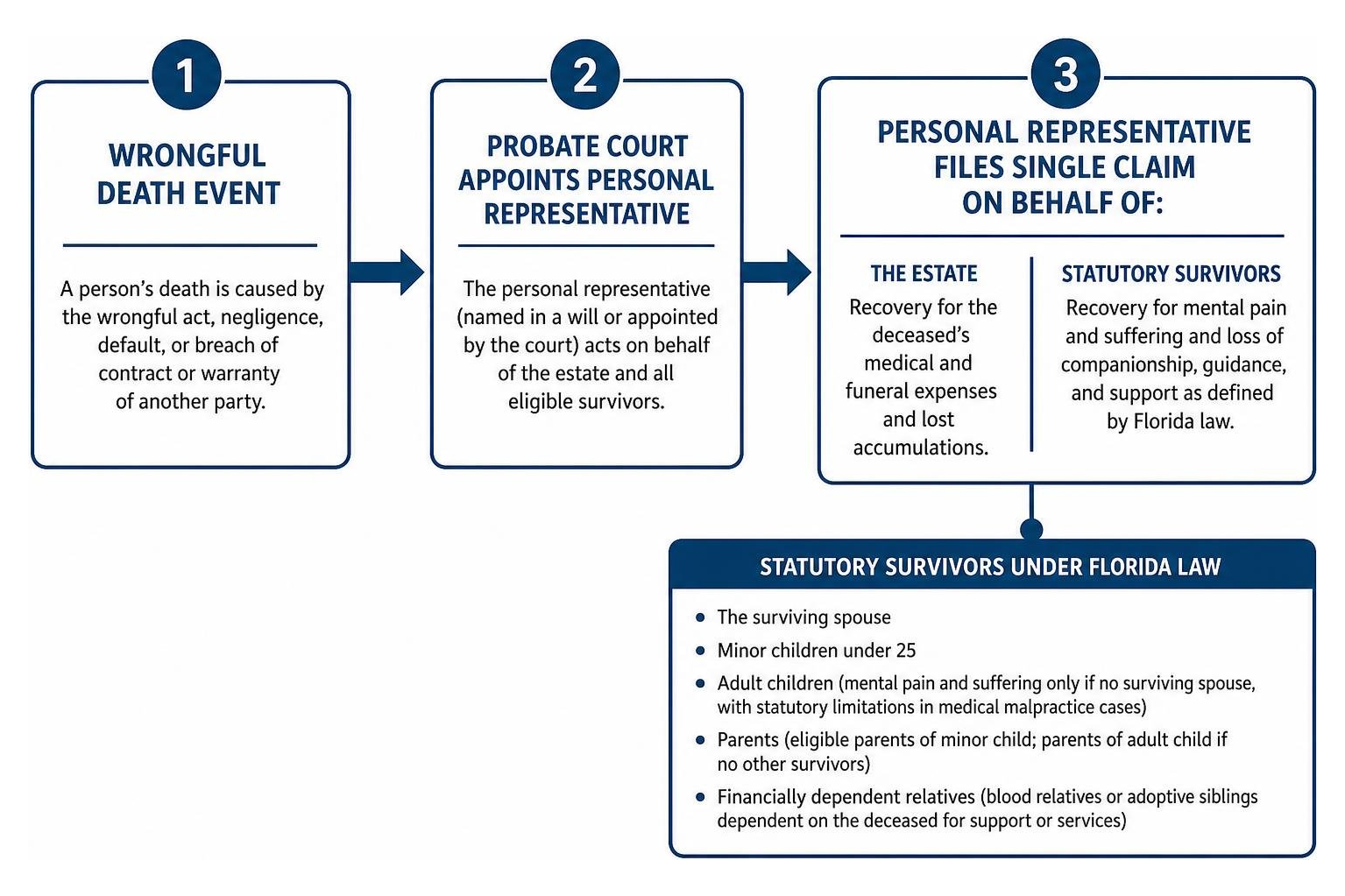
Under Florida law, a wrongful death occurs when a person’s death is caused by the wrongful act, negligence, default, or breach of contract or warranty of another party. The underlying principle is straightforward: if the deceased person would have been entitled to bring a personal injury lawsuit had they survived, their estate and survivors maintain the right to pursue a civil claim for the damages resulting from their passing.
However, Florida handles these actions differently than many other jurisdictions. Rather than allowing every grieving family member to file their own individual lawsuit, the law centralizes the process. Knowing who can file a wrongful death lawsuit in Florida helps avoid procedural delays. Under Florida Statutes § 768.20, the claim must be filed exclusively by the personal representative of the deceased person’s estate.
The personal representative (often named in a will or appointed by a probate court) acts on behalf of both the deceased’s estate and all eligible survivors seeking recovery under Florida law. The statute defines “survivors” specifically as:
- The Surviving Spouse: Entitled to recover for the loss of the deceased’s companionship and protection, as well as mental pain and suffering from the date of injury.
- Minor Children: Children under 25 years of age (as defined specifically by the Wrongful Death Act), who may recover for lost parental companionship, instruction, guidance, and mental pain and suffering.
- Adult Children: May recover for mental pain and suffering only if there is no surviving spouse, with distinct statutory limitations applying in medical malpractice cases.
- Parents: Eligible parents of a deceased minor child can recover for mental pain and suffering. Parents of an adult child may also recover for pain and suffering if there are no other survivors.
- Financially Dependent Relatives: Any blood relatives or adoptive siblings who were dependent on the deceased person for support or services, either partially or wholly.
Common Causes of Fatal Accidents Across Florida
Fatal accidents can happen anywhere—from our congested highways to commercial workplaces and private venues. Across Florida, over 1,200 wrongful death actions are filed annually, making our state one of the most active jurisdictions for civil wrongful death claims in the nation.
The vast majority of fatal negligence claims stem from a handful of recurring scenarios:
- Motor Vehicle Accidents: Accounting for roughly 60% of wrongful death claims in the state, traffic crashes remain the leading contributor. In 2023 alone, Florida experienced 3,374 fatal crashes leading to 3,555 deaths according to reports by the Florida Department of Highway Safety and Motor Vehicles. These incidents frequently involve distracted driving, speeding, drunk driving, and commercial trucking collisions along high-speed corridors like I-4, I-95, and I-75.
- Medical Malpractice: Making up approximately 20% of fatal claims, healthcare negligence occurs when doctors, surgeons, nurses, or hospital networks fail to provide an accepted standard of care. Families dealing with fatal surgical errors, misdiagnoses, or medication mistakes should review what damages can be recovered in medical negligence claims.
- Premises Liability Incidents: Comprising about 10% of cases, dangerous conditions on commercial or residential properties—such as catastrophic slip-and-fall incidents, structural collapses, pool drownings, or inadequate security resulting in violent assaults—can trigger legal liability for negligent property owners.
- Workplace and Industrial Collisions: Fatal falls from scaffolding, heavy equipment malfunctions, and electrocutions on construction sites often warrant third-party wrongful death claims against negligent contractors or equipment manufacturers.
Strict Deadlines and Florida’s Statute of Limitations
Time is a decisive factor when protecting your family’s legal rights. Florida establishes a strict two-year statute of limitations for wrongful death lawsuits, running directly from the date of the person’s death (Florida Statutes § 95.11(4)(d)).
Failing to initiate legal proceedings within this two-year window almost always results in a complete bar to recovery. Judges are legally required to grant defense motions to dismiss any claim brought outside the statutory limit, regardless of how clear the defendant’s liability might be.
There are narrow exceptions that may “toll” or pause the statute of limitations, including:
- Fraudulent Concealment: If the defendant actively and intentionally concealed their negligence or identity to prevent the family from discovering the cause of action.
- Unidentified Defendants in Hit-and-Run Collisions: Specific statutory tolling may apply in rare circumstances involving intentional evasion.
- Medical Malpractice Tolling Provisions: When pre-suit notice requirements and formal investigations briefly extend the deadline under Florida medical negligence statutes.
Because evidence deteriorates, witness memories fade, and corporate black-box data can be routinely overwritten within weeks, engaging legal counsel well before the deadline expires is critical.
Calculating Damages, Settlement Values, and Comparative Fault
Evaluating the monetary value of a fatal accident requires examining both tangible financial losses and intangible emotional harms. Average wrongful death settlements across Florida often range from $500,000 to $1.5 million, with catastrophic or multi-party corporate cases exceeding $10 million depending on insurance coverage and the deceased’s earning capacity.
Damages are categorized into two primary branches: damages awarded to the estate and damages awarded directly to individual surviving family members.
| Damage Category | Recoverable by the Estate | Recoverable by Statutory Survivors |
|---|---|---|
| Lost Earnings & Accumulations | Prospective net business/employment accumulations value | Lost financial support & services from date of injury to death |
| Future Support & Services | Not applicable to estate directly | Projected future support/services based on life expectancy |
| Medical Expenses | Medical bills paid by or charged directly against the estate | Medical bills paid directly by a survivor on behalf of decedent |
| Funeral & Burial Costs | Funeral/burial costs paid directly by the personal representative | Funeral expenses paid out-of-pocket by an individual survivor |
| Mental Pain & Suffering | Not recoverable by the estate | Recoverable by surviving spouse, minor children, and eligible parents |
| Loss of Companionship & Guidance | Not recoverable by the estate | Recoverable by spouse and minor children for lost instruction/protection |
How Florida’s Modified Comparative Fault Rule Affects Claims
Florida operates under a modified comparative fault standard (codified under Florida Statutes § 768.81). It is vital to understand how Florida’s comparative negligence rule affects injury and fatal claims.
Under this system, an injured party or deceased individual can only recover damages if their share of fault is 50% or less. If the deceased is found to be 51% or more at fault for the accident (for example, in a disputed multi-vehicle crash), the survivors and estate are entirely barred from collecting compensation.
If the deceased bears a minor share of responsibility (e.g., 20% fault for driving slightly above the speed limit when another driver ran a red light), total recoverable damages are reduced proportionally. For example, if the total awarded damages are $1,000,000, a 20% fault finding reduces the final recovery to $800,000.
Overcoming Defense Strategies and Causation Disputes
Because wrongful death claims involve significant financial exposure, commercial insurers and defense attorneys deploy aggressive tactics to minimize their liability. Common defense strategies include:
- Shifting Blame to the Deceased: Exploiting comparative fault rules to argue the deceased caused their own injuries.
- Arguing Intervening or Pre-Existing Causes: Claiming prior medical conditions or independent subsequent events caused the death rather than the defendant’s conduct.
- Challenging Survivor Dependency: Contesting the financial dependency of adult relatives or challenging the closeness of family relationships to diminish pain and suffering awards.
- Delaying Negotiations: Dragging out early communications in hopes that the family misses critical statutory deadlines or accepts an undervalued initial settlement.
Countering these maneuvers requires establishing proximate causation through objective physical evidence and expert testimony.
How a Florida Wrongful Death Lawyer Builds a Strong Case
Proving a wrongful death claim requires methodically establishing four legal elements: duty of care, breach of duty, direct causation, and quantifiable damages. Understanding how a wrongful death claim works in Florida allows families to navigate each phase with confidence.

A comprehensive investigation involves several key legal steps:
- Securing Critical Scene Evidence: Gathering black box electronic control module (ECM) data, surveillance footage, dashcam videos, scene photographs, and 911 dispatch audio before it is erased or lost.
- Interviewing Eyewitnesses and First Responders: Taking formal statements from investigating police officers, EMTs, emergency room personnel, and civilian witnesses.
- Engaging Specialized Expert Witnesses: Collaborating with accident reconstruction engineers, forensic pathologists, vocational economists, and medical specialists to prove liability and accurately project lifelong financial loss.
- Drafting Comprehensive Settlement Demands: Compiling damages into a detailed demand package backed by trial-ready trial exhibits.
- Filing Formal Litigation and Managing Discovery: Conducting depositions of defendants and corporate representatives, issuing subpoenas for internal company records, and taking the case before a jury if the defense refuses to offer a fair settlement.
Why You Need a Florida Wrongful Death Lawyer for Complex Claims
Handling a fatal claim without experienced representation places families at a severe disadvantage against well-funded insurance carriers. Navigating wrongful death disputes intersecting with general personal injury and fatal accident claims demands extensive courtroom resources and deep familiarity with state liability rules.
Our firm provides a distinct advantage: managing attorney Amanda E. Wright previously represented Fortune 100 insurance carriers. We know precisely how insurance adjusters evaluate risk, set settlement reserves, and attempt to undervalue claims. We leverage this insider perspective to build airtight cases that anticipate defense tactics at every turn.
Choosing the Right Florida Wrongful Death Lawyer for Your Family
When selecting legal counsel during this difficult period, consider the following criteria:
- Contingency Fee Structure: Reputable wrongful death attorneys handle cases on a contingency fee basis, meaning you pay zero upfront costs or legal fees unless money is successfully recovered for your family.
- Trial Readiness: Insurance companies offer top-dollar settlements only to attorneys who demonstrate a track record of taking complex cases to trial when necessary.
- Direct Attorney Communication: You deserve transparent updates, compassionate support, and direct access to your attorney throughout your case.
- Insurance Defense Insight: A lawyer who understands the defense’s playbook can dismantle their arguments before they reach the courtroom.
Frequently Asked Questions About Florida Wrongful Death Claims
What is the average wrongful death settlement amount in Florida?
While settlements typically range between $500,000 and $1.5 million, every case depends on unique factors. Settlement values are primarily driven by available insurance policy limits, the defendant’s assets, the deceased’s age and earning capacity, the number of surviving dependents, and the clarity of liability.
Can siblings or extended relatives file a wrongful death claim in Florida?
Siblings and extended family members cannot file a wrongful death lawsuit directly. Under Florida law, only the court-appointed personal representative may file. Furthermore, siblings can only recover financial damages if they can prove they were partially or wholly dependent on the deceased for financial support or services at the time of death.
How do contingency fees work in Florida wrongful death lawsuits?
Under a contingency fee agreement, legal fees are structured as a percentage of the total recovery obtained through settlement or verdict. If your attorney does not secure financial compensation, you owe nothing in attorney fees. Case costs (such as filing fees, expert witness costs, and deposition transcripts) are typically advanced by the law firm and reimbursed from the final settlement or verdict.
Conclusion
No amount of financial compensation can ever replace a beloved family member. However, a successful wrongful death claim provides necessary financial stability, covers overwhelming medical and funeral costs, and holds negligent individuals or corporations accountable for the harm they cause.
At the Law Offices of Amanda E. Wright, we combine deep compassion for grieving families with aggressive, trial-tested advocacy. From our founder’s previous experience defending Fortune 100 insurance companies, we anticipate defense strategies and fight tirelessly for the maximum compensation your family deserves.
If you have lost a loved one due to someone else’s negligence, contact our dedicated Florida wrongful death attorneys today to schedule a free, confidential consultation. We are here to carry the legal burden so you and your family can focus on healing.